

MAHAMA SIGNS 10 BILLS — THE ANTI-LGBTQ+ BILL REMAINS IN LIMBO
By: Rev. Immanuel Wiafe
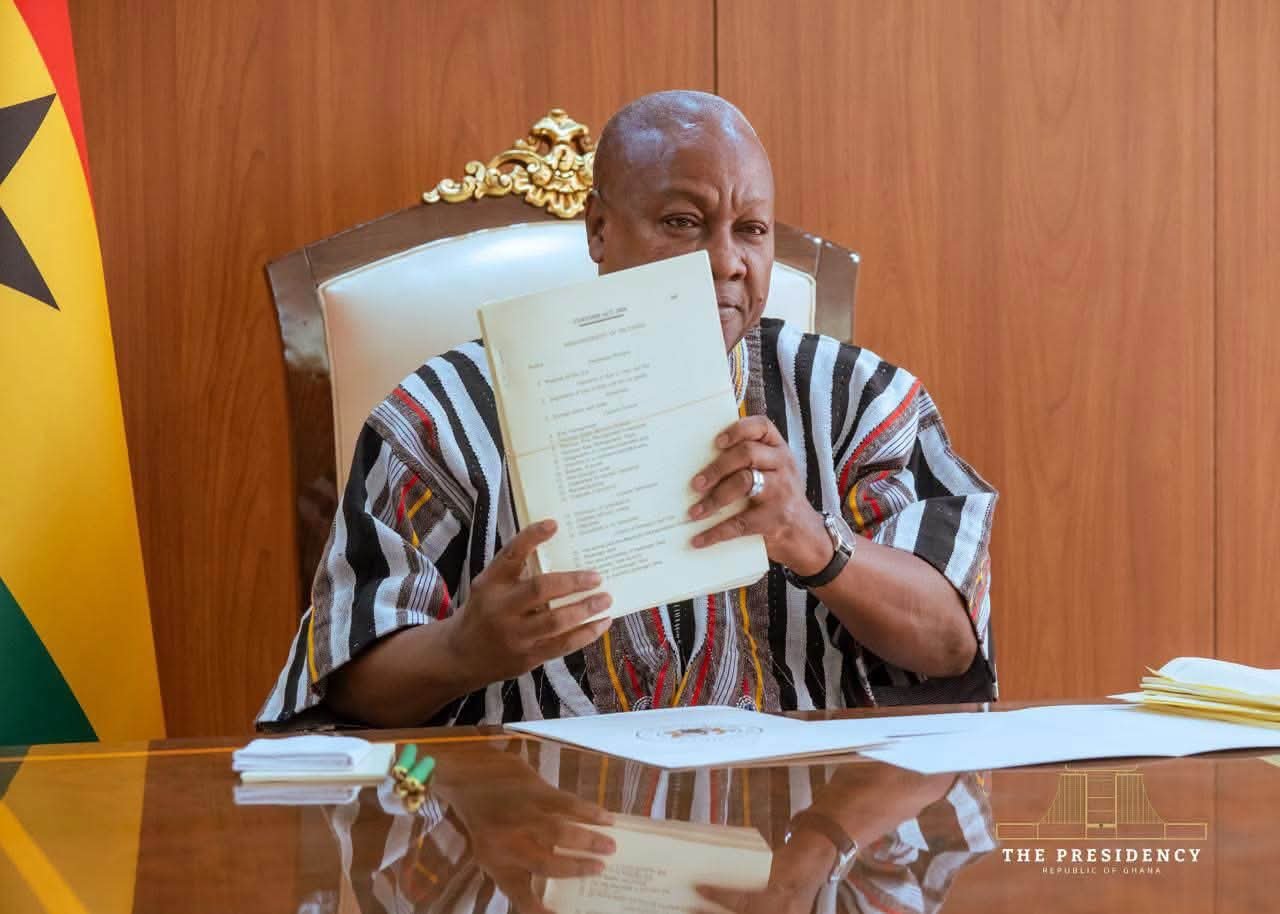
President John Dramani Mahama has assented to ten Bills passed by Parliament, turning them into laws and opening a new chapter in Ghana’s legislative and policy landscape.
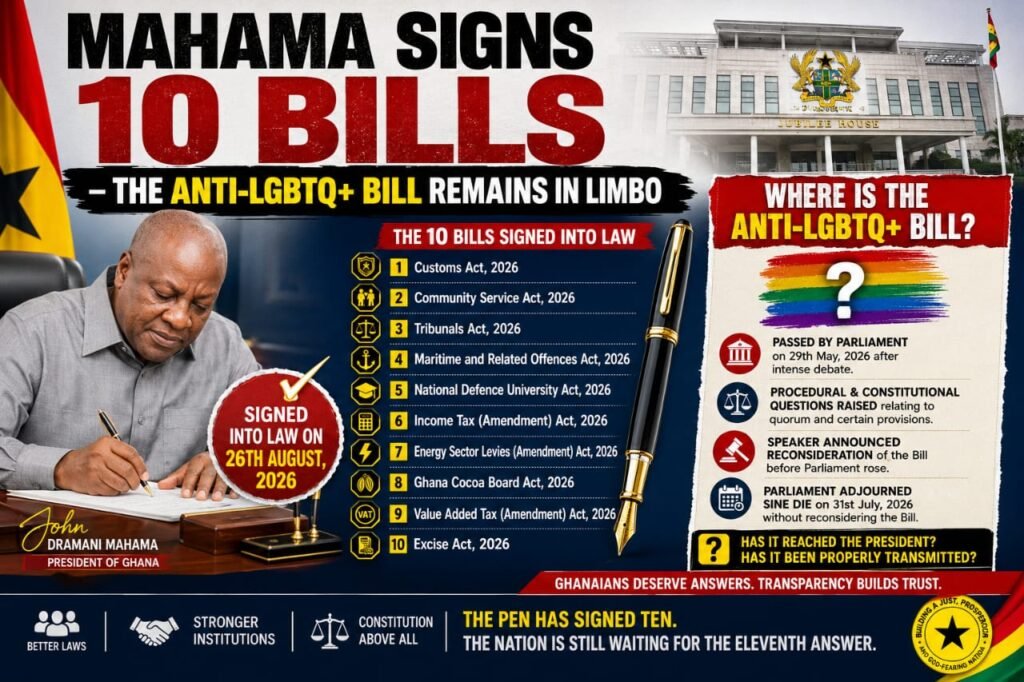
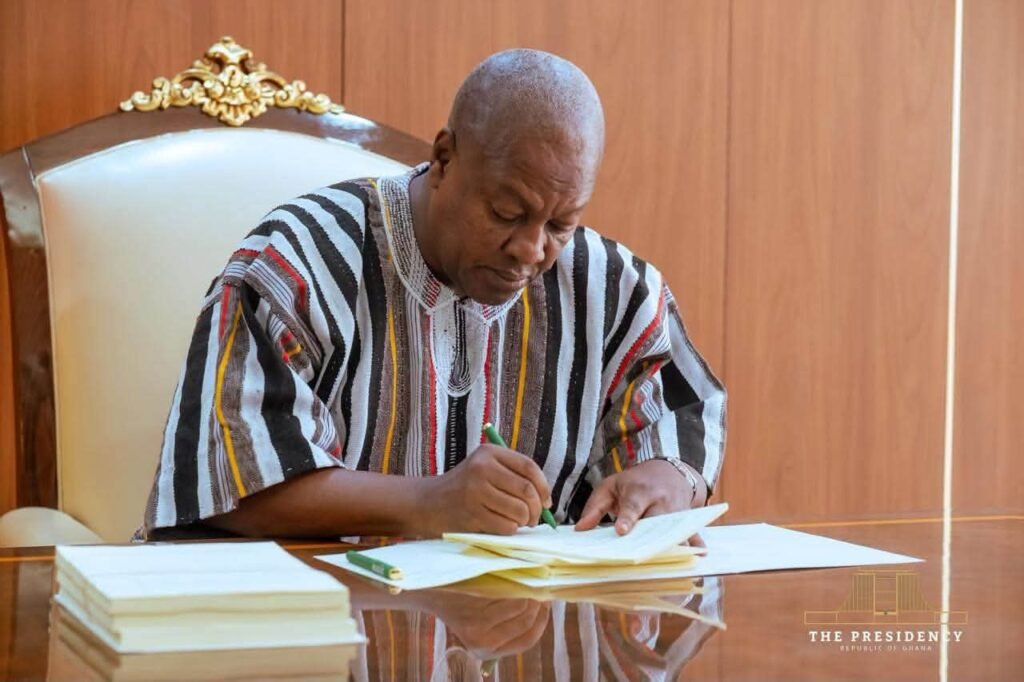
The ten laws cover customs administration, community service, tribunals, maritime offences, national defence education, income taxation, energy-sector levies, cocoa administration, Value Added Tax and excise duties. The President signed the Bills at Jubilee House on Wednesday, August 26, 2026.
For the government, the signing represents progress in implementing legislative reforms. For Parliament, it demonstrates that some of the major Bills considered during its recent sitting have successfully completed the legislative journey.
But for the ordinary Ghanaian, another question may be more important: What will these ten new laws actually change in our daily lives?
And beyond that question lies another, much more politically and socially sensitive one: Where is the Human Sexual Rights and Family Values Bill, popularly known as the Anti-LGBTQ+ Bill?
Ten Bills have reached the President’s desk and received his signature. Yet the legislation that has generated enormous public debate, religious mobilisation, political controversy and international attention remains outside the list.
The question is therefore not simply why President Mahama has not signed it.
The more fundamental question is whether the Bill has reached the constitutional stage at which the President can lawfully sign it.
TEN BILLS, TEN POTENTIAL AREAS OF IMPACT
The importance of the ten new laws should not be underestimated.
The Customs Act, 2026 consolidates existing customs legislation into a single framework, with the stated objective of making customs administration simpler and more efficient while closing loopholes that have contributed to revenue losses.
If properly implemented, this could affect importers, exporters, businesses and ultimately consumers. More efficient customs procedures can reduce delays and the cost of doing business. But the public must also watch to ensure that improved revenue mobilisation does not translate into unnecessary bureaucratic burdens for legitimate businesses.
The Community Service Act, 2026 introduces non-custodial sentences for misdemeanours and other minor offences. Instead of automatically sending certain offenders to prison, the justice system can require them to perform community service.
This is potentially significant for Ghana’s overcrowded correctional facilities. It also represents a shift towards rehabilitation and restorative justice rather than relying exclusively on imprisonment.
The Tribunals Act, meanwhile, provides for Regional and District Tribunals aimed at reducing the backlog of cases and improving access to justice. This Act before passed into law received some red-flag raised by the the Opposition NPP Presidential Candidate Dr. Bawamia
For citizens who have waited years for cases to be determined, the real value of this law will be measured in the speed and quality of justice delivered.
The Maritime and Related Offences Act strengthens Ghana’s legal framework for offences committed within the country’s maritime space. This matters to a country whose economic and security interests are closely connected to its ports, shipping, fishing and offshore activities.
The National Defence University Act establishes the legal foundation for the National Defence University. At a time when national security is no longer limited to conventional military threats, specialised education in defence, intelligence, cyber security, strategic studies and related fields can become increasingly important.
THE TAX LAWS: WILL GHANAIANS FEEL THE DIFFERENCE?
Three of the new laws have particular relevance to Ghana’s tax system.
The Income Tax (Amendment) Act, Value Added Tax (Amendment) Act and Excise Act introduce changes to the country’s tax framework. The Income Tax amendment, in particular, provides relief for people earning the minimum wage or below by exempting them from income tax.
For low-income workers, this could provide some welcome breathing space.
But Ghana’s economic reality demands that government look beyond the headline.
A tax exemption means little if food prices continue rising, transport remains expensive, rent consumes a large proportion of household income and young people struggle to find employment.
The ultimate measure of economic legislation is whether citizens experience an improvement in their disposable income and quality of life.
The Energy Sector Levies (Amendment) Act also has implications for government revenue and the energy sector. The challenge will be ensuring that the revenue raised is transparently managed and translated into meaningful national development.
Ghanaians have become increasingly sensitive to taxation because they want to know not only how much government collects but also how the money is used.
COCOA FARMERS: THE REAL TEST BEGINS NOW
Perhaps one of the most significant laws for Ghana’s agricultural economy is the Ghana Cocoa Board Act, 2026.
The new legislation provides a fresh statutory framework for COCOBOD and includes a commitment to local processing as well as a provision aimed at ensuring cocoa farmers receive at least 70 percent of the Free on Board price. This could be transformative if properly implemented.
But Ghanaian cocoa farmers have heard many promises over the years.
The farmer in the village is therefore unlikely to be impressed merely because a Bill has become an Act of Parliament.
The farmer wants to know: Will my income increase? The cocoa farmer’s concerns centre on five critical issues: the timeliness of payments, the state of cocoa roads, the availability of fertiliser and farm inputs, the threat of illegal mining to farmlands, and—most fundamentally—whether their children stand to inherit a better future because of their labour.
Those are the questions that will determine whether the new Cocoa Board Act becomes a genuine agricultural intervention or simply another piece of legislation.
THEN COMES THE BILL EVERYONE IS ASKING ABOUT
Against this background, the conspicuous absence of the Human Sexual Rights and Family Values Bill from the ten Bills signed by President Mahama has naturally generated questions.
The Bill was passed by Parliament on May 29, 2026, after extensive debate and amendments. It has been one of the most controversial pieces of legislation in Ghana’s recent history.
Its supporters (Ghanaians) argue that it is necessary to protect Ghanaian family values, culture and social norms.
Opponents have raised concerns about aspects of the legislation, particularly provisions relating to fundamental rights, criminalisation, discrimination and the possible constitutional implications of the proposed law.
But regardless of where one stands on the substance of the Bill, one fact must be respected. A Bill is not automatically law simply because Parliament has voted for it.
The 1992 Constitution establishes the legislative process. Article 106 provides that Parliament makes laws through Bills passed by Parliament and assented to by the President. Where a Bill is presented to the President, Article 106(7) provides for presidential assent or refusal, subject to the constitutional procedure, including possible referral to the Council of State. That means the constitutional process matters.
DID PARLIAMENT FAIL TO SEND THE BILL TO THE PRESIDENT?
This is where the public debate needs greater accuracy.
President Mahama stated in June that the Anti-LGBTQ+ Bill had not yet reached the Presidency and that questions had arisen about the circumstances under which Parliament passed it.
Among the concerns he identified were questions about parliamentary quorum and possible procedural lapses. He said the Attorney-General and the legal advisers at the Presidency would examine the matter once the Bill reached the President.
This is an important point.
The President did not simply say, “I have received the Bill and I refuse to sign it.”
Rather, his position was that there were unresolved legal and procedural questions surrounding the Bill before it could properly reach the stage of presidential assent.
There were also concerns raised publicly about whether Parliament had the constitutionally required quorum when the Bill was passed. Legal experts pointed to Article 104(1), which sets requirements for decisions of Parliament, and linked the issue to previous Supreme Court jurisprudence on parliamentary quorum.
Therefore, it would be premature to conclude that President Mahama has deliberately kept the Bill on his desk. The evidence points instead to a Bill whose legislative journey became complicated after its passage.
PARLIAMENT’S SECOND CHANCE AND THE MISSED OPPORTUNITY
The developments in July made the situation even more interesting. On July 30, Speaker Alban Bagbin told the National Chief Imam, Sheikh Osman Nuhu Sharubutu, that Parliament intended to reconsider the Bill before the House adjourned.
The Speaker said the legislation required further review, particularly three clauses concerning sentencing provisions. That assurance created an expectation that Parliament would revisit the legislation and complete the process.
But Parliament adjourned sine die on July 31 without reconsidering the Bill. According to the Ghana News Agency, a motion to rescind the earlier decision was listed on the Order Paper but the House could not adopt it before the adjournment.
That development is crucial. It means that while Parliament passed the Bill in May, the House did not complete the subsequent reconsideration process before going on recess.
So, when President Mahama signs ten other Bills on August 26 and the Anti-LGBTQ+ Bill is absent, the public should not immediately assume that the President has rejected it.
The more defensible conclusion is that the Anti-LGBTQ+ Bill remains caught in a constitutional, procedural and parliamentary process that has not yet been satisfactorily completed.
DID THE PRESIDENT ASK PARLIAMENT TO SEND IT TO HIM?
This is another question that deserves a factual answer.
There is no evidence presently available showing that President Mahama formally demanded that Parliament transmit the Anti-LGBTQ+ Bill to him for signature.
What is publicly documented is that he acknowledged the Bill, recognised its significance, and stated that there were procedural and constitutional issues that needed to be resolved. He also said that, once the Bill reached the Presidency, it would undergo legal scrutiny.
The President also indicated that he had several constitutional options available to him. That position should not necessarily be interpreted as support for or opposition to the substance of the Bill.
It is, at least on its face, an argument for constitutional procedure. And that distinction matters.
THE POLITICAL QUESTION WILL NOT DISAPPEAR
Nevertheless, the political pressure surrounding the Bill is unlikely to disappear. The legislation has attracted support from sections of the Christian and Muslim communities, traditional leaders and other groups who see the protection of family values as an important national responsibility.
At the same time, human-rights organisations, civil-society groups and international actors have raised concerns about provisions of the legislation. The President is therefore sitting at the intersection of law, politics, religion, culture, diplomacy and human rights.
Whatever decision eventually emerges will carry consequences beyond the walls of Parliament and Jubilee House.
THE PRESIDENT MUST NOT BE ABOVE THE CONSTITUTION AND PARLIAMENT MUST NOT BE BELOW IT
There is a larger principle here that Ghana must not lose sight of. If Parliament passes a Bill, it must pass it according to the Constitution.
When the President receives a Bill, he must act according to the Constitution. Also, If Parliament is required to reconsider provisions, it must do so according to its rules and constitutional obligations.
And if constitutional disputes arise, the courts must be allowed to perform their constitutional role independently.
This is bigger than President John D. Mahama. This transcends partisan lines. It rises above the NDC and the NPP. It goes beyond the Anti-LGBTQ+ debate itself.
At its core, this is a test of whether Ghana’s democratic institutions can operate within the bounds of the law—even when the political stakes could not be higher.
TEN SIGNATURES, BUT ONE BIG QUESTION
President Mahama’s signing of the ten Bills is undoubtedly significant. The laws have the potential to affect workers, cocoa farmers, importers, businesses, prisoners, taxpayers, the justice system, maritime security and national defence.
But implementation will determine whether the legislation improves the lives of ordinary Ghanaians. And while the country begins to assess the impact of these ten new laws, one question will continue to hang over the political landscape.
What happens to the Human Sexual Rights and Family Values Bill? The answer is not simply that President Mahama has refused to sign it.
The available evidence indicates that the Bill has faced unresolved questions over parliamentary procedure, quorum and provisions requiring further review. Parliament itself acknowledged the need for reconsideration but adjourned on July 31 without completing that process.
Therefore, the public deserves clarity from Parliament. The path of the Bill requires clarity at every stage. Should it remain with Parliament, that fact ought to be stated. In the event of a proper transmission to the Presidency, the Executive should confirm it. And where constitutional defects are alleged, the legal reasoning must be made explicit.
And if the President eventually refuses assent, Ghanaians deserve to know precisely why. Silence creates suspicion. Transparency creates confidence.
CONCLUSION
The signing of ten Bills into law should not be reduced to a political victory for the government or a ceremonial event at Jubilee House. It should be judged by what happens next.
The pressing questions are these: Will the new tax laws offer genuine fiscal relief or simply redistribute the tax burden? Will the cocoa legislation translate into higher incomes for farmers? Can community service initiatives effectively decongest Ghana’s prisons? Will the tribunals expedite legal proceedings? Are customs reforms sufficient to curb delays and corruption? Will the maritime legislation bolster national security? And can the National Defence University cultivate the strategic leadership Ghana requires? These are the practical tests of the new agenda.
But alongside them stands the unresolved political and constitutional question of the Anti-LGBTQ+ Bill.
President Mahama has signed ten. One remains in limbo. The responsible thing now is not to manufacture an answer. It is to demand one.
Ghanaian citizens deserve to know where the Bill is, what stage of the constitutional process it has reached, what Parliament intends to do when it reconvenes, and what the Presidency will do if and when the legislation is properly presented for consideration.
Because in a constitutional democracy, no Bill however popular, controversial, religiously sensitive or politically explosive should be above the Constitution. And neither Parliament nor the Presidency should be allowed to hide behind silence.
The pen has signed ten. The nation is still waiting to know what happens to the eleventh question.

