


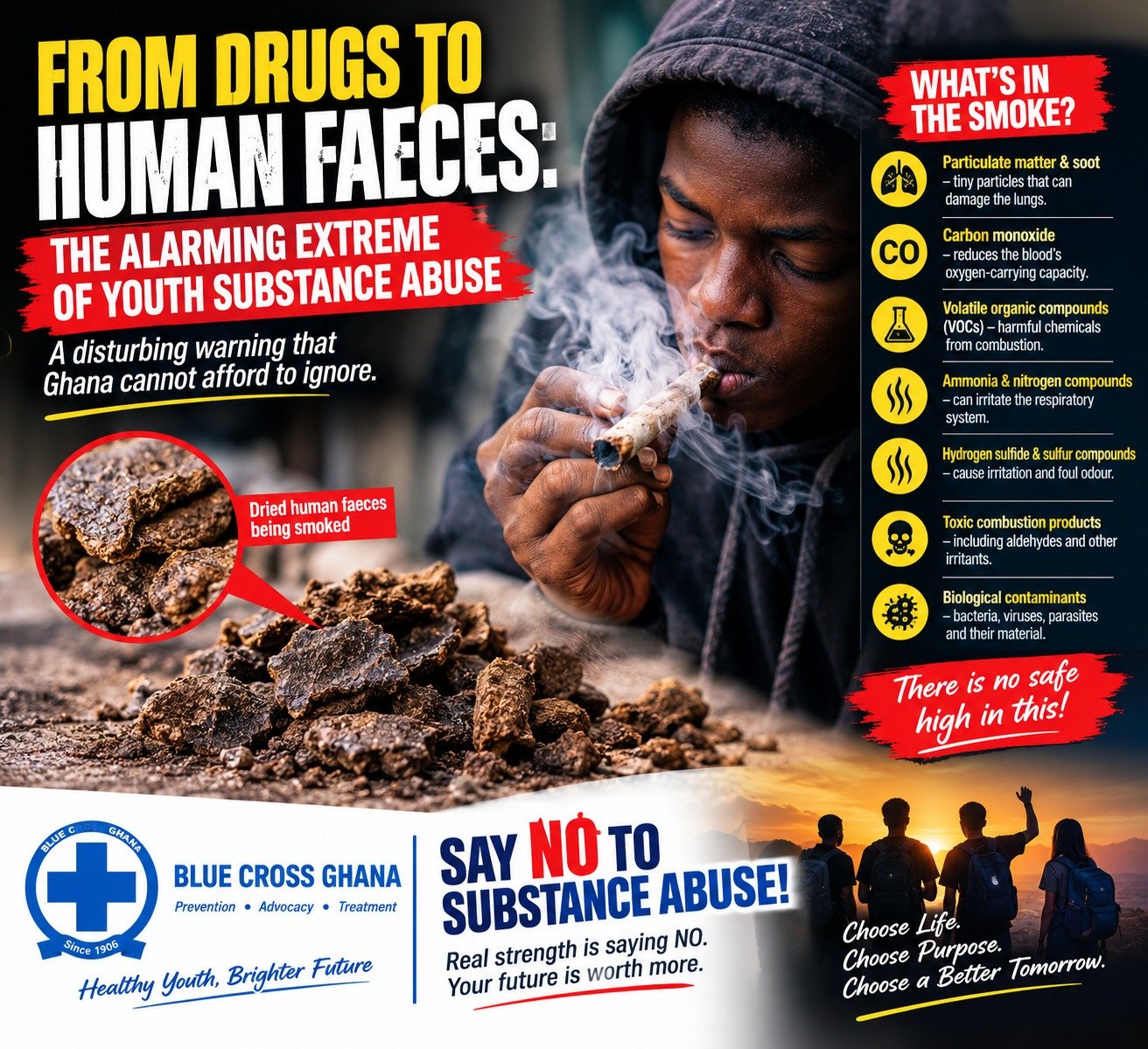
A disturbing warning that Ghana cannot afford to ignore
By: Rev. Immanuel Wiafe
The disturbing reports of some young people experimenting with smoking dried human faeces should send shockwaves through every home, school, church, community and institution responsible for the welfare of Ghana’s youth.
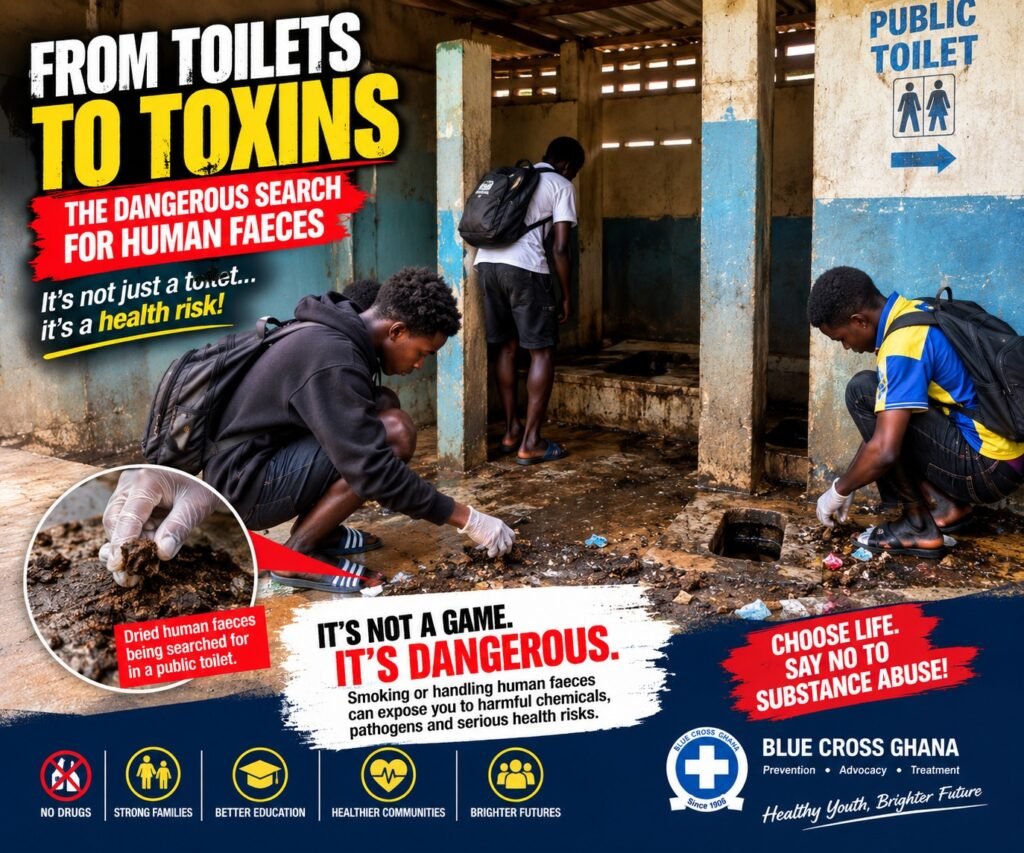
It is not simply the shocking nature of the practice that should concern the nation. It is the question behind it: What is happening to our young people that some are prepared to experiment with substances and practices that expose them to potentially serious health dangers?
The reported smoking of dried human faeces represents an extreme and deeply worrying dimension of substance experimentation. Human faeces are not a conventional recreational drug, and it would be scientifically misleading to suggest that smoking them produces a particular drug-induced “high” from one identifiable chemical. However, burning faecal matter can produce smoke containing particulate matter, carbon monoxide, volatile organic compounds and other irritating or potentially toxic combustion products. Dried faecal material may also contain biological contaminants, including bacteria, viruses and parasites.
The danger, therefore, is real even if the supposed intoxicating effect reported by some users is poorly understood.
THE BIGGER QUESTION
The nation must look beyond the shocking headline and ask why a young person would even consider putting such material into a fire and inhaling the resulting smoke.
Youth substance abuse rarely begins with the most extreme behaviour. It can begin with curiosity, peer pressure, experimentation, the desire to belong, the search for excitement, emotional distress, boredom, misinformation or the belief that one has discovered something that can provide an unusual experience.
One experiment can lead to another.
A young person who begins by experimenting with one substance may eventually encounter others through friends, social networks or informal drug markets. The search for something stronger, cheaper, different or more accessible can expose vulnerable young people to increasingly dangerous substances and practices.
This is why the disturbing reports surrounding the smoking of dried human faeces should not merely become another social-media sensation. It should become a national wake-up call.
WHEN CURIOSITY BECOMES DANGEROUS
Young people are naturally curious. Adolescence is a period of exploration, identity formation and increased sensitivity to peer influence. But curiosity without accurate information can become dangerous.
Social media has also changed the speed at which strange practices can travel. Something that would once have remained confined to one small group can potentially be demonstrated, discussed, copied and normalised among young people within a short period.
The danger becomes greater when young people believe that because something is “natural,” “traditional,” “cheap” or not officially classified as a drug, it must therefore be safe. That assumption is false.
Smoke is not automatically safe because the substance being burned is not a conventional narcotic.
Burning organic material produces new chemical compounds. Inhaling smoke exposes the respiratory system to particles and gases that the body was never designed to receive.
In the case of dried human faeces, there is an additional concern: biological contamination. Drying does not necessarily guarantee that all pathogens have been eliminated. Although combustion may destroy many microorganisms, handling contaminated material, inhaling dust from it or inhaling incompletely burned material can create additional health concerns.
WHAT ARE THEY REALLY SEARCHING FOR?
Perhaps the most important question for parents and policymakers is not simply, “Why are young people doing this?”
We must ask: What are they searching for?
Some may be searching for pleasure. Others may be searching for acceptance.
Some may be attempting to escape emotional pain, frustration, family difficulties or academic pressure. Others may simply be following friends.
For some, experimentation may be driven by the desire to demonstrate courage or prove themselves to a peer group.
There may also be young people who have developed patterns of substance dependence and are increasingly willing to experiment with unconventional materials when access to their preferred substances becomes difficult.
Each situation requires understanding and appropriate intervention.
This does not mean excusing dangerous behaviour. Rather, it means recognising that punishment alone cannot solve the underlying problem.
THE ROLE OF THE CHURCH
The Presbyterian Church of Ghana, through Blue Cross Ghana, has a long history of addressing alcohol and substance-abuse prevention, advocacy and treatment.
The organisation’s 120th Anniversary celebration at Aburi on Saturday, September 26, 2026, provided an important opportunity to renew the call for stronger action against substance abuse.
Speaking at the anniversary, the Director of Mission and Evangelism of the Presbyterian Church of Ghana, Rev. Opoku Baffour, pledged his personal support and that of the Mission and Evangelism Department to enable the work of Blue Cross to move forward smoothly.
He also identified chaplains in various Senior High Schools as important partners in the prevention campaign, saying they were ready to collaborate with Blue Cross to impact lives positively through prevention programmes.
That call deserves serious attention. If prevention is to succeed, the message cannot remain in conference rooms.
It must reach the classroom.
It must reach the dormitory.
It must reach the football field.
It must reach the church youth fellowship.
It must reach the family dining table.
And it must reach the young person who is already experimenting with substances.
SCHOOLS ARE A CRITICAL BATTLEGROUND
Senior High Schools provide an important platform for prevention.
School chaplains, counsellors, teachers, parents and student leaders can play complementary roles in helping young people understand the dangers of substance abuse before experimentation becomes dependence.
Prevention education must go beyond telling students, “Drugs are bad.”
Young people need to know why certain substances are dangerous, how peer pressure operates, how addiction develops, how social media can influence behaviour and where they can seek help.
They must also be encouraged to talk about emotional difficulties without fear of ridicule or automatic punishment.
A young person struggling with substance use should not be treated simply as a bad child.
There may be a deeper problem requiring professional attention.
THE FAMILY CANNOT BE LEFT OUT
Parents and guardians also have a major responsibility. The first line of prevention is often the home.
Parents need to know their children’s friends, behavioural changes, online influences and emotional struggles.
Sudden changes in behaviour, secrecy, declining academic performance, withdrawal from family activities, unexplained financial demands and changes in social circles may sometimes signal difficulties that deserve attention.
But parents must avoid responding to every warning sign with anger and humiliation.
Communication matters.
A young person who is afraid to speak to a parent may turn to peers or the internet for answers. And not every answer found there will be safe.
PRAYER AND PREVENTION
Rev. Opoku Baffour also emphasised that prayer must remain an important aspect of whatever Blue Cross undertakes.
That is particularly significant within the Presbyterian tradition.
Prayer, however, should complement, not replace, education, counselling, medical care, rehabilitation, research and community intervention.
The fight against substance abuse requires both spiritual and practical responses. Families can pray while seeking professional help.
Churches can preach against substance abuse while supporting rehabilitation. Schools can teach prevention while providing counselling.
Government and civil society organisations can strengthen enforcement while expanding prevention and treatment services.
A MESSAGE TO THE YOUTH
To Ghana’s young people, the message must be direct: Do not allow curiosity to gamble with your future.
Something being circulated on social media does not make it safe.
Someone claiming that a substance produces a particular sensation does not make the claim scientifically true.
And peer pressure does not disappear simply because everyone in the group is doing something.
Your lungs, brain, heart and other organs are not experimental laboratories.
Do not allow anyone to persuade you to inhale, swallow or inject an unknown substance simply to prove that you are brave.
Real courage includes the ability to say no.
A NATIONAL RESPONSIBILITY
The reported experimentation with dried human faeces should therefore be understood as more than an unusual or bizarre story.
It is a disturbing reminder of how far substance experimentation can potentially go when curiosity, peer pressure, misinformation and inadequate prevention intersect.
Ghana must strengthen prevention programmes at every level.
The Church must continue its advocacy.
Schools must intensify education and counselling.
Parents must become more attentive.
Health professionals must be empowered to provide treatment and rehabilitation.
Community leaders must speak openly about substance abuse.
The media must educate without glamorising dangerous behaviour.
And young people themselves must become part of the solution.
The challenge before Ghana is not merely to stop one shocking practice.
It is to prevent a generation from becoming trapped in a culture of experimentation that can destroy health, education, relationships and future opportunities.
The 120-year history of Blue Cross Ghana demonstrates that prevention is not a new conversation.
But the emerging patterns of substance experimentation tell us that the conversation must become louder, more creative and more relevant to today’s youth.
The question confronting the nation is therefore no longer simply, “What are young people smoking?”
It is:
“What are we doing early enough to stop them from reaching the point where they will smoke anything at all?”
That is the conversation Ghana must have, and have now.

