


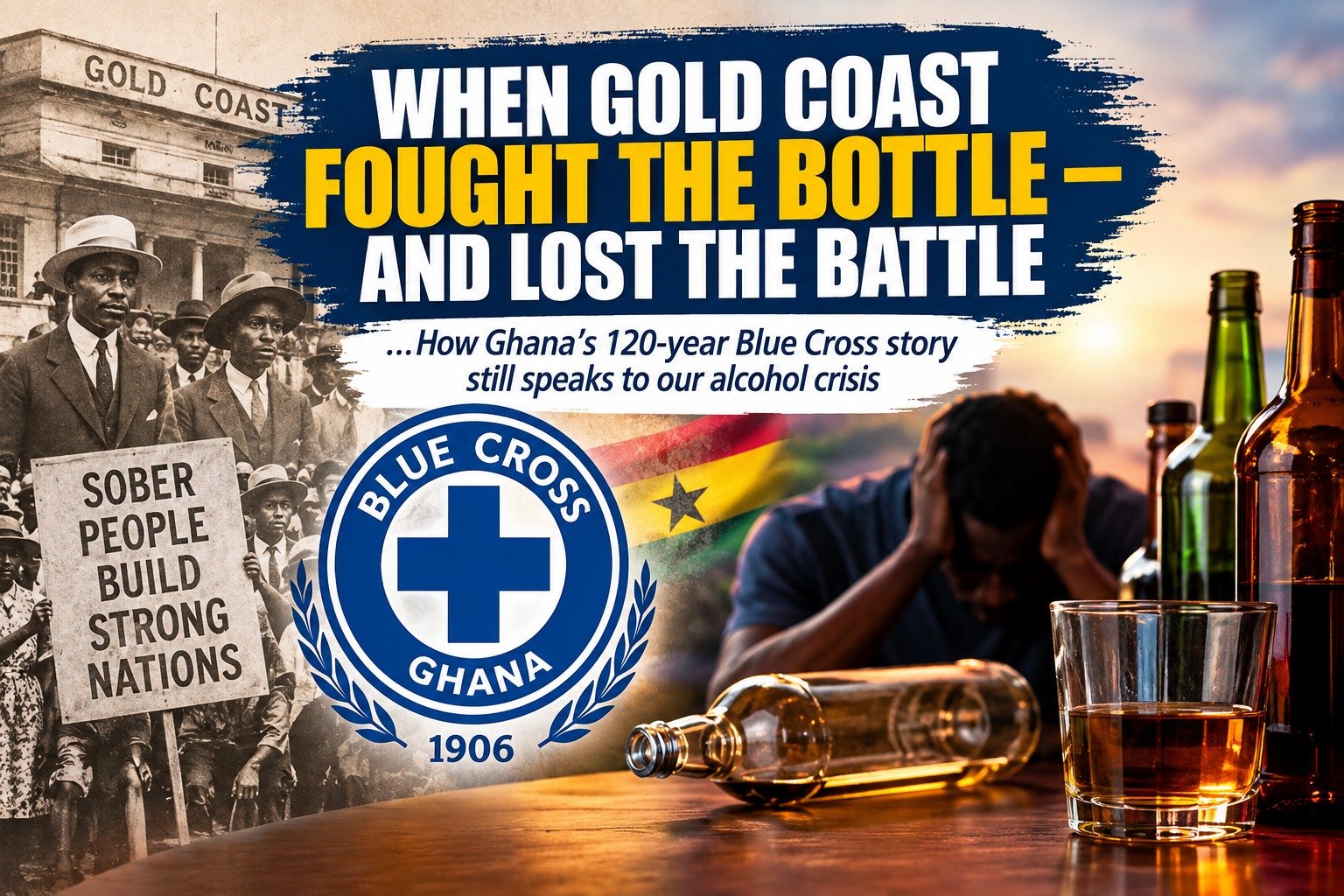
…How Ghana’s 120-year Blue Cross story still speaks to our alcohol crisis
By: Rev. Immanuel Wiafe (Ga West Presbytery Media Team Lead)
A forgotten chapter of Ghana’s history reveals how one movement challenged the liquor trade, confronted colonial interests and warned a nation about the social cost of alcohol.
There are moments in the history of a nation when the wisdom of the past becomes a painful commentary on the present.
Ghana’s 120-year history of the Blue Cross is one such moment.
Long before alcohol abuse, addiction and substance use became subjects of national policy discussions, health campaigns and social interventions, a small but determined movement in the then Gold Coast was already warning the people about the destructive consequences of intoxicating liquor.
The Blue Cross did not merely preach abstinence. It challenged a system. It confronted a commercial culture that profited from alcohol, raised public consciousness, mobilised traditional leaders, reached out to people struggling with alcoholism and, remarkably, influenced government action on the importation and production of alcoholic beverages.
Today, as Ghana continues to grapple with alcohol-related social and health problems, the history of the Blue Cross raises an uncomfortable question: What might Ghana look like today if the warnings of those early temperance advocates had received sustained national support?
The story began far from Ghana.
From Switzerland to the Gold Coast. In September 1877, Rev. Louis Lucien Rochat founded the Swiss Temperance Society in Geneva, Switzerland. The movement later evolved into the Blue Cross. Its philosophy was closely connected with the idea of rescuing people whose lives had been damaged by alcohol, much as the Red Cross sought to assist those wounded in war.
Through missionary activity, the movement spread beyond Switzerland, eventually contributing to the formation of the International Federation of the Blue Cross in 1886. The organisation was established as an independent movement without political or denominational allegiance. Its fundamental objective was to help people affected by alcohol and other drug-related problems and promote a lifestyle free from alcohol and drug abuse.
It was this movement that eventually found its way to the Gold Coast.
In 1906, Basel Mission medical doctor Rudolf Fisch introduced the organisation into Ghana. He gave it the local name “Anidaho Fekuw,” meaning “Society of Sober People.” According to the historical account, this was the first Blue Cross society established in Africa.
The movement began at Aburi and quickly spread to communities where the Basel Mission had established stations. The Church used the society as an instrument of evangelism, particularly among people struggling with alcoholism and alcohol-related problems.
But Dr. Fisch was not simply interested in telling people not to drink.
He had seen the consequences with his own eyes. The doctor who saw beyond the bottle
At a mass meeting in Aburi on January 13, 1907, Dr. Fisch spoke passionately about the destructive effects of alcohol on families and communities.
He had observed fertile lands being sold, only for the proceeds to be spent on liquor. He warned that the drinking problem was not merely an individual matter. If one person became poor through alcohol, the entire community ultimately suffered.
His position was strikingly holistic.
He viewed temperance as a social responsibility, a Christian responsibility and a public health responsibility. As a medical doctor, he had treated patients who regularly consumed schnapps and other intoxicating drinks and had become sick as a result.
Fisch therefore declared that he would fight intemperance with all his might. He understood the struggle not simply as a religious campaign but as a battle for the wellbeing of human beings and communities.
The first members of the movement adopted practical rules. They agreed to meet weekly, pay membership dues and organise monthly excursions to expand the work.
They also confronted a sensitive cultural question: palm wine.
Their decision was uncompromising. Members resolved neither to consume nor offer palm wine, including at funerals. Soon, Blue Cross members were travelling from village to village carrying their flag and singing songs associated with the movement.
The message resonated.
Traditional leaders became involved.
At Odumase, Chief Mate Korle mobilised his people and 55 people, including non-Christians, signed abstinence pledges. At Kpone, the chief presided over a meeting where 88 people pledged to abstain from alcohol. By October and November 1907, branches had been established at Kukurantumi and Kyebi, while branches were also formed at Nsaba and Kumasi-Adum.
By the end of that remarkable first year, Gold Coast had 21 local branches and more than 900 members. The Gold Coast was admitted into the International Federation of the Blue Cross that same year. This was not a fringe movement. It was becoming a social force. When the bottle became a national question The early Blue Cross campaign was significant because it moved the alcohol question beyond individual morality. It exposed the relationship between alcohol, poverty, family life, health and social development.
The historical record states that Blue Cross members became increasingly conscious of what they regarded as exploitation associated with the liquor trade. People who had been excluded from church life because of adultery, polygamy or alcoholism were welcomed into the Blue Cross. The movement sought not merely to condemn people but to help them recover.
That approach created tension.
Some missionaries were uncomfortable with the fact that people excluded from church membership and even non-Christians could have rights and responsibilities within the Blue Cross. Dr. Fisch, however, defended the inclusion of those who were struggling.
The result was a clash of approaches. On one side was a movement advocating rehabilitation, inclusion and democratic participation.
On the other was an ecclesiastical environment in which certain people had already been excluded or disciplined.
The conflict eventually affected the movement. When Dr. Fisch presented the Blue Cross report to the church’s Annual Conference in 1907, restrictions were placed on excluded church members and pagans holding office in the Blue Cross. Some affected members withdrew from the organisation.
The Blue Cross therefore found itself fighting on two fronts: dealing with internal resistance while also confronting those who did not understand or accept Fisch’s principles. Yet the movement continued to make an impact.
A movement that reached the colonial government
Perhaps the most extraordinary chapter in the history concerns Dr. Fisch’s confrontation with the liquor trade and the colonial government.
The historical account traces the introduction of intoxicating liquor into the Gold Coast to centuries of commercial interaction with European merchants, including the Portuguese, Dutch and Danes. Among the commodities traded were whiskey, rum and schnapps.
According to the document, the merchants were primarily concerned with commercial profit and paid little attention to the social, moral and spiritual consequences of alcohol consumption among the people.
Dr. Fisch challenged this system.
He openly criticised the merchants and the government of the day. Strong protests and representations were submitted to the Colonial Secretary.
And something happened.
The government eventually complied with Fisch’s request. Alcoholic liquor importation was reduced, while the distillation of Akpeteshie was prohibited by law.
This is one of the most remarkable parts of Ghana’s temperance history.
More than a century ago, a medical missionary and a civil society movement were arguing that commercial access to alcohol could have consequences for the health and wellbeing of society. Their advocacy reached the highest levels of the colonial administration and contributed to restrictions on alcohol.
The lesson is profound: public health advocacy is not a modern invention.
Ghanaians were already debating the relationship between commerce, government responsibility and social wellbeing more than a century ago.
When the warning voice became weaker
But history also shows what happened when the movement lost its strongest voice. In 1911, the Basel Mission transferred Dr. Fisch to Cameroon.
The historical record makes a direct connection between his departure and the resurgence of alcohol importation and trade. It states that alcohol importation “bounced back” at the convenience of the government of the day and that the trade in alcoholic beverages gained momentum. At the same time, the young Blue Cross movement suffered from a lack of leadership and encouragement.
This was a turning point.
The early movement weakened. Some members failed to maintain their abstinence commitments, and most local branches became inactive, leaving the Aburi group as the surviving nucleus.
Then came the twentieth century.
Beer and other alcoholic beverages increasingly flooded the Ghanaian market. In 1931, the first brewery, Accra Brewery, was established on Ghanaian soil. The Blue Cross history describes these developments as contributing to the promotion of alcoholism.
The warning voice had become weaker just as the commercial alcohol system was becoming stronger. That historical sequence deserves serious reflection. The consequences of abandoning prevention The purpose of history is not to romanticise the past. It is to understand the choices that shaped the present.
The Blue Cross experience demonstrates the importance of prevention.
For decades, the organisation concentrated largely on preventing alcoholism and drug abuse. It educated communities, organised awareness programmes and encouraged people to adopt alcohol-free lifestyles.
Eventually, however, the problem became so significant that the organisation moved beyond prevention into treatment.
In 1999, Ghana Blue Cross entered the treatment of alcohol and other drug victims. A 20-bed ward at Pantang Psychiatric Hospital was adopted for the treatment of alcoholism. The arrangement involved the Ministry of Health, Blue Cross and other partners, with the government providing significant medical and institutional support while Blue Cross contributed to furnishing and rehabilitation-related programmes.
This transition tells its own story.
A movement that began warning society about alcohol eventually found itself helping to treat people suffering from the consequences of alcohol and drug abuse.
Prevention had become treatment. The social warning had become a medical reality. What happened to the holistic approach? The Blue Cross vision was never limited to telling people, “Do not drink.”
It recognised the whole person.
The historical record describes Dr. Fisch as concerned with the individual as well as public consciousness. He followed up people who had been excluded from the Church because of adultery, polygamy and drinking. He believed warnings and punishment alone could not save people and emphasised the power of God working through humanity.
This holistic approach remains relevant. Alcohol misuse does not affect only the drinker.
It can affect spouses, children, household finances, education, productivity, road safety, mental wellbeing, workplaces, communities and the criminal justice system.
The costs may therefore be carried by people who never purchased a bottle.
That is why the Blue Cross story should not be reduced to a religious prohibition against alcohol. At its heart was an argument about the wellbeing of society. A movement that deserves to be remembered
The Blue Cross survived difficult periods.
There were attempts to revive the work in the 1950s and 1960s. National conferences and courses from 1963 sought to equip members, churches and the general public to fight alcoholism and drug abuse.
In the 1990s, the organisation even pursued a fruit juice project, training members to produce syrups, squash, juice, lemonade and nectar as alternatives to alcoholic beverages and as income-generating activities.
The organisation also established a recreational and counselling centre at Bawku and continued its prevention and awareness programmes.
Yet the history records another troubling development: Blue Cross Sunday, or Drug Awareness Week, which dates back to the missionary era, has not always received the attention expected from congregations. The document records concern about inadequate support from some church leaders and cites a 1999 Synod Clerk’s report lamenting that the organisation had been left to struggle despite the importance of its work.
That is perhaps the greatest irony of all. A movement that once challenged government and the liquor trade could later find itself struggling for institutional attention.
Ghana must remember before it forgets
As Ghana marks 120 years of Blue Cross existence, the country has an opportunity to revisit a chapter of its history that deserves much greater public attention.
The story of Blue Cross is not simply the story of a church organisation. It is the story of public advocacy.
It is the story of traditional leaders taking responsibility for the welfare of their communities.
It is the story of a medical professional recognising that illness cannot always be separated from social conditions.
It is the story of citizens challenging a commercial system whose products they believed were harming their communities.
And it is the story of a movement whose warnings were, at different moments, strengthened by government action and weakened by institutional neglect.
The historical record does not support the simplistic conclusion that every present-day social problem in Ghana is caused by alcohol, nor does it establish a direct causal chain between the weakening of Blue Cross and every later development in the alcohol industry.
But it does establish something important: Ghana’s early temperance movement identified alcohol as a serious social problem, organised against it, mobilised communities, challenged the liquor trade and succeeded in influencing government restrictions at the time.
That achievement should not disappear from national memory. The question before Ghana today is not necessarily whether the country can recreate the Gold Coast of 1907. It cannot.
The question is whether the spirit of prevention, community mobilisation, evidence-based advocacy, rehabilitation and concern for the whole person can once again become central to the national conversation on alcohol and drug abuse.
The Blue Cross experience suggests that society pays a price when prevention is neglected.
It also suggests that civil society, faith communities, traditional authorities, health professionals and government can work together when a social problem is treated as a collective responsibility.
One hundred and twenty years after the Blue Cross first appeared in the Gold Coast, perhaps the most important tribute Ghana can pay to its pioneers is not merely to celebrate their anniversary.
It is to remember their warning. They saw the problem when it was still possible to confront it at an early stage. They challenged the merchants. They challenged government.
They challenged the Church.
They challenged communities. And, above all, they challenged a society to think beyond immediate commercial gain and consider the human cost.
The bottle has changed. The brands have changed. The economy has changed. The country has changed. But the fundamental question remains:
What kind of society do we want to build—and what price are we prepared to pay when we ignore the warnings of those who saw the danger coming?
The 120-year history of the Blue Cross gives Ghana an opportunity to answer that question again. And perhaps this time, the warning should not be forgotten.
_Source/ historical credit: Rev. J. Otchere-Mireku, former President (1990–1993) and General Secretary (1994–2002) of the Blue Cross Ghana._

