


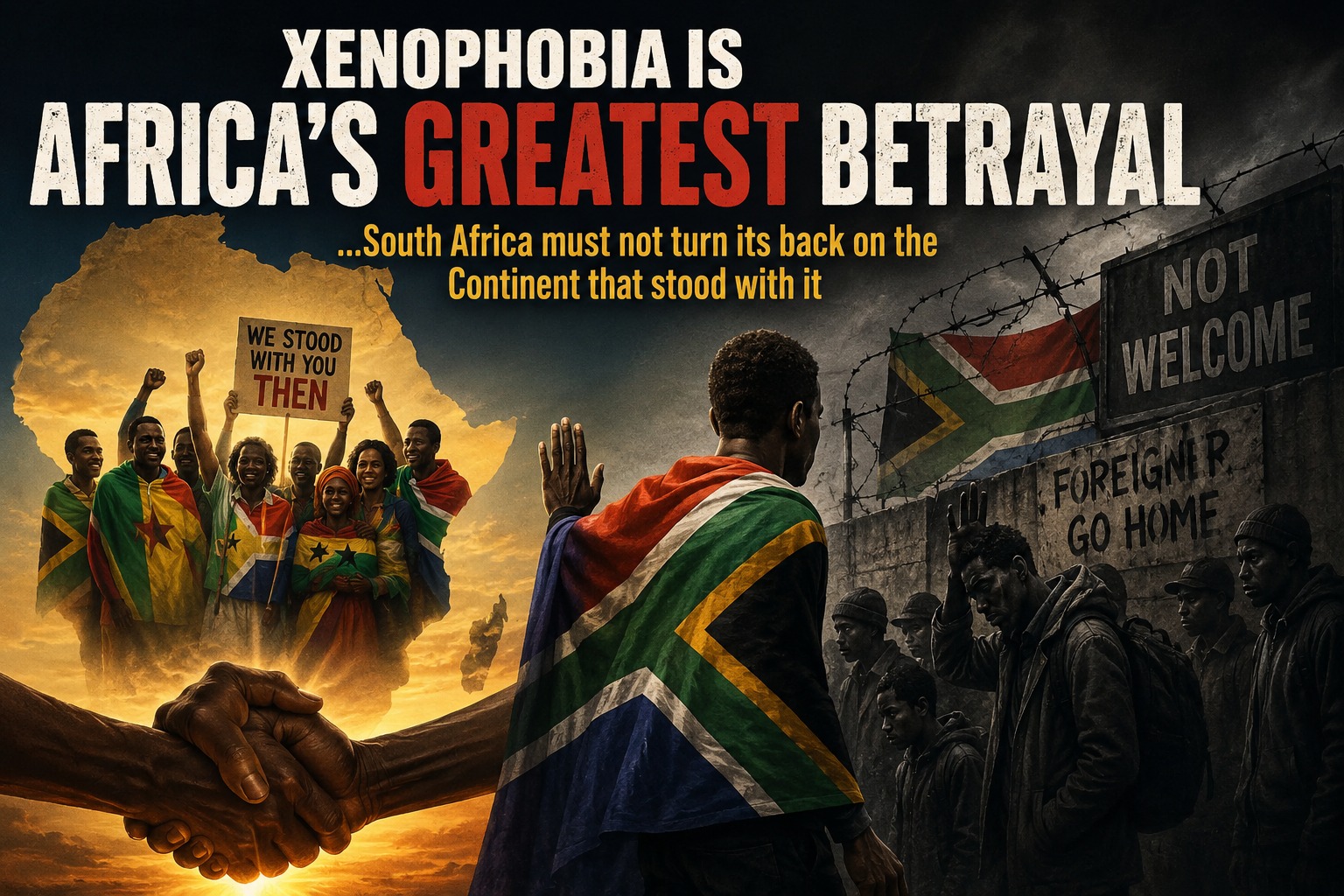
…South Africa must not turn its back on the Continent that stood with it
By: Rev. Immanuel Wiafe
There is an African proverb that says, “When ten houseflies gather around filth, no one can convince them that honey is sweeter.” It is a disturbing metaphor, but one that speaks to the danger of collective thinking driven by anger, misinformation and prejudice. Once hatred becomes normalised, truth struggles to find a place. Once fear replaces reason, even innocent people become targets.
That is precisely what Africa continues to witness whenever xenophobic violence erupts in South Africa.
Every attack on a foreign-owned shop, every assault on an African migrant, every threat against those whose only “crime” is seeking a better life is not merely a criminal act against individuals. It is an assault on African unity. It is a rejection of a shared history. It is a painful betrayal of the solidarity that helped dismantle apartheid and gave birth to the democratic South Africa the world celebrates today.
The question confronting the continent is simple but uncomfortable: Has South Africa forgotten where it came from?
There was a time when the South African passport carried little value because apartheid had isolated the country from much of the international community. There was a time when countless South Africans crossed borders not as tourists or investors, but as refugees, students, political exiles and freedom fighters. They sought safety, education and support from neighbouring African states and from countries across the continent.
They were welcomed. They were sheltered. They were educated. They were protected.
African governments opened their borders. Churches prayed for their liberation. Ordinary citizens contributed resources to sustain the anti-apartheid struggle. Ghana, Zambia, Tanzania, Nigeria, Botswana and many other African nations stood shoulder to shoulder with South Africans during one of the darkest periods in modern African history. They did so not because they expected repayment, but because they believed that the freedom of one African nation was the responsibility of all Africans.
Today, that same spirit of Pan-African solidarity appears to be under serious threat.
The recurring attacks against foreign nationals in parts of South Africa raise troubling questions about the direction of one of Africa’s leading democracies. While it is important not to paint every South African with the same brush, it is equally important not to minimise the seriousness of repeated xenophobic violence. Too often, these incidents have become predictable cycles of intimidation, destruction of property, looting and physical attacks that leave families traumatised and entire communities living in fear.
Silence in the face of such violence is dangerous. Indifference is even more dangerous.
South Africa has every right to protect its borders, enforce its immigration laws and address illegal migration through lawful means. Every sovereign nation possesses that authority. No country is expected to abandon its security responsibilities.
However, there is a fundamental difference between enforcing immigration laws and unleashing violence against fellow Africans.
There is a profound difference between public policy and mob justice.
There is an even greater difference between patriotism and xenophobia.
When innocent traders are attacked because of their nationality, when businesses are destroyed because their owners speak a different language, and when entire communities are threatened simply because they were born elsewhere, society has crossed a dangerous moral line.
What makes the situation even more troubling is the narrative often used to justify these attacks.
Foreigners are frequently blamed for unemployment. They are blamed for crime. They are blamed for pressure on public services. They are blamed for rising poverty.
Yet evidence consistently shows that complex economic challenges cannot be reduced to the presence of immigrants alone. South Africa’s unemployment crisis is rooted in structural economic inequality, educational disparities, governance failures, corruption, slow economic growth and historical injustices that predate the arrival of many migrants.
It is politically convenient to identify a visible scapegoat.
It is far more difficult to confront deep-rooted systemic failures.
History teaches that societies under economic pressure often search for someone to blame. Migrants become easy targets because they are visible, vulnerable and frequently lack political protection.
But blaming foreigners has never built a stronger economy.
Destroying businesses has never created employment.
Violence has never produced prosperity.
Instead, xenophobia destroys investor confidence, weakens tourism, damages South Africa’s international reputation and undermines the constitutional values of equality, dignity and human rights upon which modern South Africa was founded.
Perhaps the greatest irony lies in the fact that South Africans themselves are among the millions of Africans living beyond their national borders.
Across Europe, North America, Asia, Australia and the rest of Africa, South Africans pursue education, employment, business opportunities and professional careers. They contribute meaningfully to the economies and societies that host them. They expect protection under the law. They expect fairness. They expect respect.
Rightly so.
Should those same expectations not be extended to fellow Africans living in South Africa?
If a South African doctor is welcomed in Britain, if a South African engineer thrives in Australia, if a South African entrepreneur prospers in Ghana, Kenya or Botswana, why should a Ghanaian trader, a Zimbabwean teacher, a Nigerian businessman or a Malawian worker live in fear in Johannesburg or Durban?
Reciprocity is not merely good diplomacy. It is basic justice.
The African Continental Free Trade Area represents one of the most ambitious economic projects in the continent’s history. It seeks to increase trade, encourage investment and deepen regional integration. Yet economic integration cannot succeed where people themselves are unwelcome.
Trade does not move independently of people. Investment follows confidence. Confidence depends upon stability. Stability requires mutual respect.
The dream of a borderless African economy cannot coexist with streets where African migrants fear violence because of their nationality.
Political leaders across the continent also bear responsibility. They must resist exploiting anti-immigrant sentiments for political advantage. Economic frustration should never become an excuse for hate-filled rhetoric. Responsible leadership requires honesty with citizens about the true causes of unemployment, poverty and inequality.
Governments cannot solve economic problems by encouraging people to look for enemies among their neighbours.
Neither should African governments remain silent whenever xenophobic violence occurs. Diplomacy should not mean quiet acceptance of injustice. Genuine friendship sometimes requires uncomfortable conversations.
South Africa remains one of Africa’s most influential nations. With that influence comes responsibility.
Its constitutional democracy, independent judiciary and vibrant civil society provide strong foundations for confronting xenophobia. Many South Africans including religious leaders, community organisations, academics, journalists, trade unions and ordinary citizens have repeatedly condemned xenophobic violence and demonstrated remarkable solidarity with migrants. Their voices deserve recognition and support because they represent the best of South Africa’s democratic tradition.
The fight against xenophobia, therefore, is not Africa versus South Africa.
It is humanity versus hatred. It is truth versus misinformation. It is justice versus prejudice.
The younger generation of South Africans must especially embrace this responsibility. Many were born after apartheid. They enjoy freedoms secured through sacrifices made by countless Africans beyond their borders. History cannot simply become another chapter in a school textbook.
It must remain a moral compass.
Young Africans everywhere should understand that today’s migrant could be tomorrow’s citizen, investor, researcher, entrepreneur or employer. Migration has shaped every civilisation in history. Human mobility is neither new nor uniquely African. People have always crossed borders in search of peace, education, employment and opportunity.
The question is not whether migration will continue.
It will.
The question is whether Africa will manage migration through law, cooperation and compassion or through violence, fear and division.
The answer will define the continent’s future.
South Africa occupies a special place in Africa’s story. It inspired millions through its peaceful democratic transition. It produced leaders whose commitment to reconciliation became a model for the world. Those achievements should never be overshadowed by recurring scenes of xenophobic violence.
The memory of Nelson Mandela cannot comfortably coexist with the persecution of fellow Africans.
The ideals of Desmond Tutu cannot flourish alongside hatred directed at innocent migrants.
The spirit of Ubuntu loses its meaning when hospitality gives way to hostility.
Africa deserves better. South Africa deserves better. Our children deserve better.
No nation becomes great by turning against those seeking honest work. No economy grows through fear. No society secures lasting peace by replacing dialogue with violence.
Africa’s destiny has never been one of isolation. It has always been one of interconnectedness. The liberation of one nation strengthened another. The prosperity of one country should contribute to the prosperity of the continent.
It is time to reject the politics of blame.
It is time to reject the language of hatred.
It is time to reject the violence that diminishes us all.
South Africa once taught the world that reconciliation is stronger than revenge and that justice can triumph over oppression. It must now teach the continent another lesson that African solidarity is stronger than xenophobia.
History is watching.
Africa is watching.
The world is watching.
May South Africa choose once again to stand on the right side of history not by words alone, but by ensuring that every person who lives peacefully within its borders, regardless of nationality, enjoys the dignity, safety and humanity that every African deserves.

