

By: Rev. Immanuel Wiafe
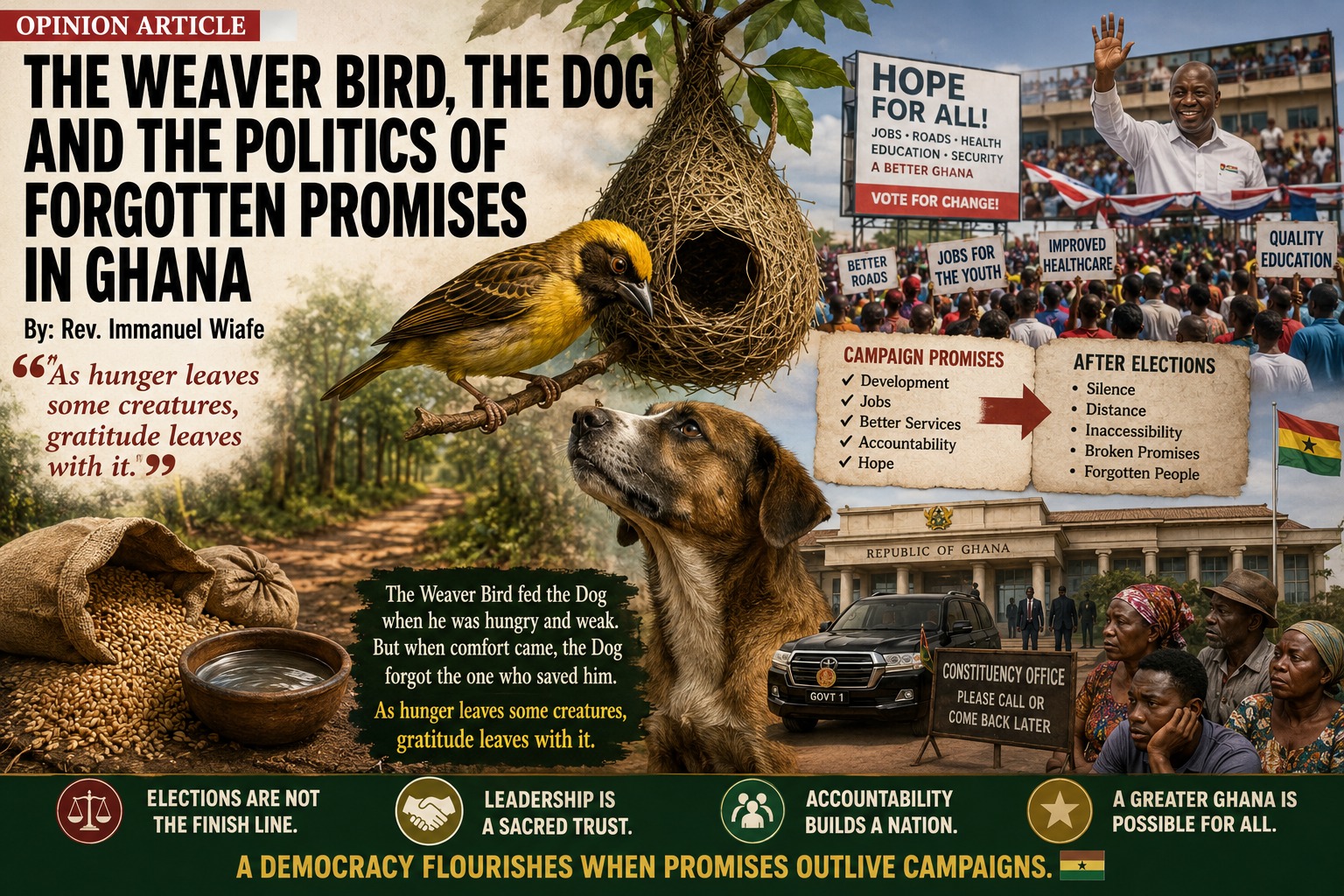
“As hunger leaves some creatures, gratitude leaves with it.”
Sometimes, the most profound lessons about leadership, loyalty and human nature are not found in political science textbooks or constitutional documents, but in simple stories. One such story is that of a Weaver Bird and a Dog.
The Dog was weak, hungry and close to death. Alone in the forest, he wandered without direction, searching for food and hoping for survival. Then a compassionate Weaver Bird appeared. She became more than just a passer-by; she became his source of life. Day after day, she led him to a hidden granary, pecked open sacks of grain so he could eat, and brought him water from a nearby stream. Through her kindness, the Dog regained his strength.
One day, however, a hunter found the Dog and took him home. There, life became comfortable. He had shelter, food, warmth and protection. His days of hunger became a distant memory.
When the Weaver Bird later flew to visit him, expecting to be welcomed by the friend she had helped save, she was met with coldness.
“The hunter told me,” the Dog said quietly, “that a dog and a bird cannot be friends.”
The Weaver Bird paused before responding with words that echo far beyond the forest:
“As hunger leaves some creatures, gratitude leaves with it.”
For many Ghanaians, this story bears an uncomfortable resemblance to our political experience.
Every four years, Ghana’s democratic landscape transforms. Communities that have not seen political leaders for years suddenly become destinations for campaign tours. Roads are hurriedly repaired. Community durbars are organised. Churches and mosques receive visitors they have not seen since the previous election cycle. Chiefs, youth groups, market women, transport unions, teachers, nurses and farmers all become the focus of intense political attention.
The ordinary Ghanaian suddenly becomes important.
The struggling trader is assured that better days are coming.
The unemployed graduate is promised jobs.
The farmer is promised better markets and improved roads.
The teacher is assured of reforms.
The health worker is promised improved conditions of service.
The youth are told they are the future.
The elderly are assured they will not be forgotten.
Campaign platforms become theatres of hope. Microphones amplify promises. Billboards smile with confidence. Television studios and radio stations become battlegrounds of competing visions for a better Ghana.
Whether it is the National Democratic Congress (NDC) or the New Patriotic Party (NPP), as well as the others, the language during campaigns is remarkably similar. Every election season carries promises of economic recovery, improved healthcare, better education, stronger security, employment opportunities, improved infrastructure, lower cost of living, the fight against corruption and national unity.
Listening to campaign speeches, one could easily conclude that every problem confronting Ghana has already been solved on paper.
Then comes Election Day. The people vote. A government is formed. Cabinets are announced. Appointments are made. Motorcades replace campaign pickups. The urgency that characterised campaign seasons gradually fades.
For many citizens, the politicians who once knocked on their doors become increasingly distant. Phone calls go unanswered. Constituency offices become difficult to access. The warmth of campaign days slowly disappears behind layers of protocol, bureaucracy and political convenience.
The Weaver Bird has once again been forgotten.
This is not to suggest that governments do nothing after assuming office. That would be inaccurate and unfair. Every administration since the Fourth Republic has made meaningful contributions to Ghana’s development. Roads have been constructed. Schools have been built. Hospitals have been expanded. Social intervention programmes have been introduced. Electricity access has increased. Water projects have been undertaken, and digital transformation has advanced in many sectors.
These achievements deserve recognition. However, acknowledging progress should not prevent us from asking difficult questions about accountability and consistency. Why do campaign promises often seem far more ambitious than the realities citizens experience? Why do communities receive extraordinary attention only during election years? Why does accessibility to political leaders diminish after victory?
Why do citizens increasingly feel remembered only when another election approaches? These questions are not directed at one political party alone. They are questions for Ghana’s entire political class. The challenge is bigger than the NDC. It is bigger than the NPP. It is about the political culture we have gradually accepted as normal.
Democracy was never intended to function as a relationship activated only during elections. It is supposed to be an ongoing covenant between leaders and citizens. Elections merely determine who governs; they do not end the responsibility of leaders to listen, explain, engage and remain accountable.
Unfortunately, our politics often resembles seasonal farming. Politicians sow promises during campaigns, harvest votes during elections, and then leave the fields unattended until another planting season arrives.
Meanwhile, the ordinary Ghanaian continues to carry enormous burdens. The young graduate searches endlessly for employment. Parents struggle with rising educational expenses. Businesses battle unstable economic conditions. Farmers worry about market access and input costs. Communities continue to demand better roads, reliable water supply and quality healthcare. Many citizens simply desire dignity, opportunity and honest leadership. Their expectations are not unreasonable.
Leadership, after all, is not measured merely by the ability to win elections. It is measured by the willingness to honour the trust that citizens freely place in those they elect.
One of the greatest dangers confronting any democracy is not disagreement between political parties. Healthy competition strengthens democracy. The greater danger is when citizens lose confidence that political promises carry genuine meaning.
When trust declines, voter apathy increases. When voter apathy grows, democratic participation weakens. When participation weakens, democracy itself suffers. That is why gratitude matters in politics.
Gratitude is demonstrated not through speeches but through service.
It is shown when elected leaders remain accessible.
It is shown when governments communicate honestly about challenges instead of making excuses.
It is shown when promises are pursued with determination even when circumstances become difficult.
It is shown when the ordinary citizen continues to matter after the campaign posters have been removed.
The Weaver Bird expected neither reward nor applause.
She expected remembrance. Citizens likewise are not asking for perfection.
No government can fulfil every campaign promise exactly as planned. Global economic shocks, pandemics, wars, natural disasters and changing fiscal realities can alter priorities. Ghanaians understand these complexities.
What citizens find difficult to accept is silence, neglect and the perception that they become politically relevant only during election seasons.
The strength of Ghana’s democracy has always rested on the maturity of its people. Time and again, Ghanaians have demonstrated remarkable patience, tolerance and commitment to constitutional governance. Peaceful transfers of power have earned our nation international admiration.
But democracy should not merely be peaceful. It should also be responsive. It should reward honesty. It should encourage accountability. It should place citizens not politicians at the centre of governance.
This responsibility does not belong solely to governments.
Citizens themselves must become more demanding of accountability. We must evaluate political parties not only by campaign rhetoric but by measurable performance. We must ask informed questions, insist on transparency and reject politics built entirely on slogans, insults and personality cults.
The media, civil society organisations, religious bodies, traditional authorities and educational institutions all have important roles to play in sustaining national accountability beyond election periods.
Perhaps our greatest challenge is not that politicians make promises. Promises are essential in every democracy.
The greater challenge is ensuring that promises become policies, policies become programmes, and programmes produce measurable improvements in people’s lives.
Until that happens consistently, the Weaver Bird’s words will continue to resonate across Ghana’s political landscape:
“As hunger leaves some creatures, gratitude leaves with it.”
May those who seek political office remember that power is borrowed from the people and must always be exercised in their interest.
May those entrusted with leadership remember that elections are not the finish line but the beginning of a sacred responsibility.
And may every Ghanaian voter remember that the ballot is not merely a tool for choosing leaders; it is also a powerful instrument for demanding accountability.
A nation prospers when leaders remember the people who entrusted them with authority. A democracy flourishes when promises outlive campaigns.
And Ghana will reach even greater heights when gratitude, integrity and faithful service remain stronger than the temporary attraction of political power.

