


By: Rev. Immanuel Wiafe
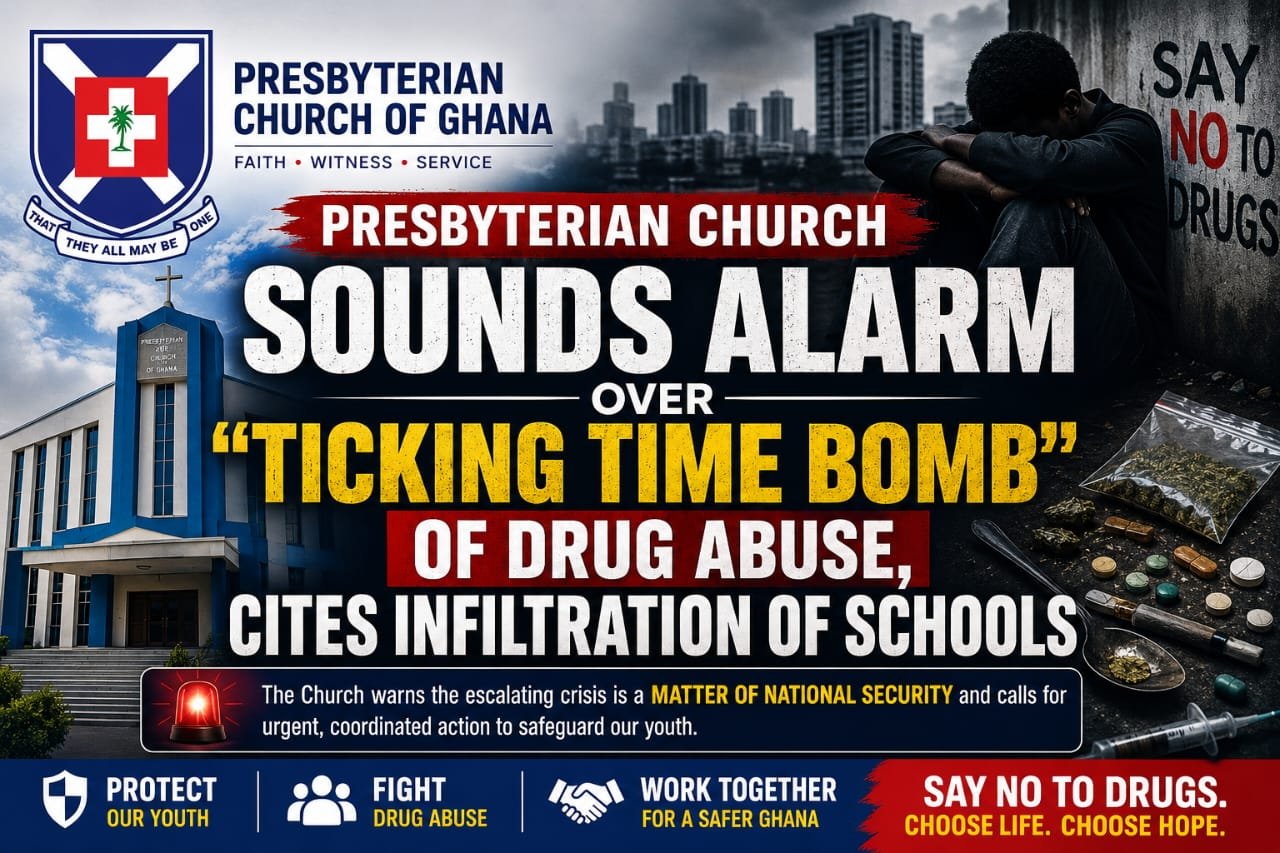
The Presbyterian Church of Ghana (PCG) has renewed its alarm over what it describes as an escalating national crisis of drug and opioid abuse, warning that the situation in the country’s urban centres has become a “ticking time bomb” requiring urgent, coordinated action.
In a communiqué issued at the close of its 26th General Assembly, held at the Ramseyer Training Centre, Abetifi-Kwahu, the Church said it had raised the alarm over the worsening drug situation in its official communiqués for the past two years, but the crisis had only deepened.
The Assembly noted that a walk through Kwame Nkrumah Circle in Accra at any hour, or a visit to informal settlements and “ghettos” in the country’s urban centres, lays bare the scale of the problem, which it said demands immediate, collaborative intervention from the state, security agencies, religious bodies and civic groups alike.
The Church pointed to its own century-long record on the issue, noting that its Ghana Blue Cross arm has spent more than 120 years working to tackle substance abuse in the country. Despite this, the PCG said, the crisis “persists and evolves,” underscoring the need for stronger action from all stakeholders.
Among the substances of greatest concern, the Church named marijuana and the West African street drug “kush,” which it described as highly addictive and destructive. It also flagged the growing misuse of “Red” the drugs Tapentadol and Carisoprodol as well as Tramadol, an opioid painkiller long associated with abuse in parts of West Africa.
Of particular concern to the Assembly was the spread of these substances into schools. The communiqué cited reports of drug peddling at the basic, secondary and tertiary levels of education, which it said amounted to a matter of national security.
The Church also weighed in on Ghana’s emerging medicinal cannabis and industrial hemp industry, cautioning that the legal permission granted for the cultivation and processing of therapeutic cannabis and industrial hemp for medicinal purposes must be closely monitored to prevent it from being exploited and turning into a wider menace.
The PCG commended the Narcotics Control Commission for its intervention in arresting five students from a Ghanaian university over their alleged involvement in producing and selling cannabis-infused edibles, including cannabis ice cream, sobolo and toffees, as well as raw cannabis.
The Church issued an urgent appeal to the Ghana Police Service, religious bodies and other civic stakeholders to forge a unified front against the drug menace, warning that the country’s youth remain the primary victims of the crisis.
“We must act decisively to safeguard the future of our youth, the primary victims of this catastrophe,” the communiqué stated.
The 26th General Assembly, held partly virtually from July 31 to August 11 and in person from August 12 to 16, 2026, brought together commissioners and delegates from across the PCG’s presbyteries under the theme “Celebrating Our Heritage: Building on the Foundation Already Laid,” ahead of the Church’s bicentenary celebrations in 2028.

