


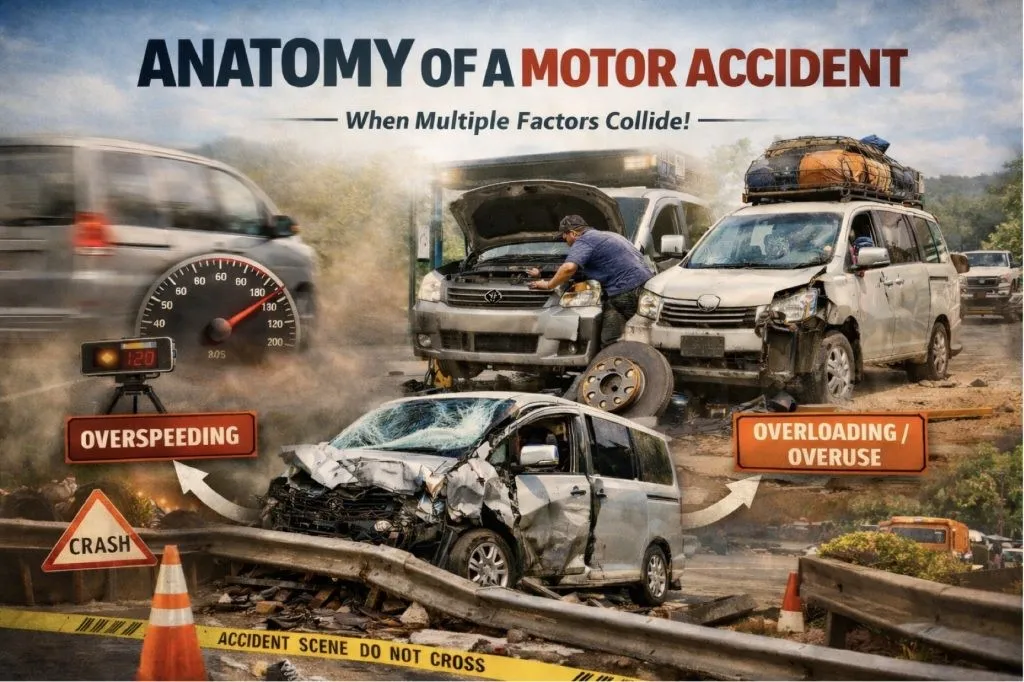
Ghana’s Road Accident Truth: Why Private Drivers Top Fatal Crash Statistics in 2025
Every day, an average of eight people lose their lives on Ghanaian roads .
When you witness the hectic manoeuvring of a trotro (commercial minibus) in heavy traffic, it is easy to point fingers.
If asked which drivers cause the most accidents, most Ghanaians would confidently blame commercial drivers.
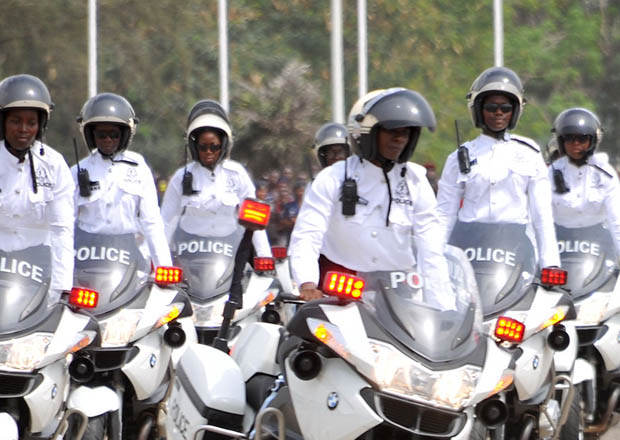
However, the data from the National Road Safety Authority (NRSA) and the Motor Traffic and Transport Department (MTTD) tells a completely different story.
This article dissects the latest 2025 statistics to reveal the real offenders, the actual causes of road carnage, and why the national conversation on road safety needs to shift.
The Statistical Shock: Private Vehicles Lead in Crash Involvement
Contrary to popular belief, commercial vehicles are not the primary culprits in road accidents. According to provisional data from the NRSA, private vehicles account for the largest share of road crashes in Ghana.
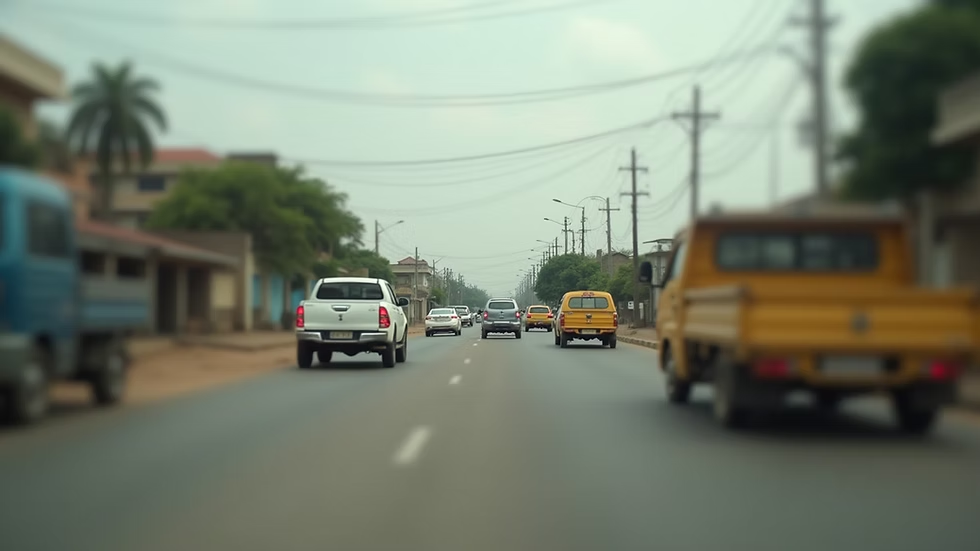
In the first half of 2025, private vehicles were involved in 41% of all road crashes, significantly outpacing commercial vehicles which stood at 34% .
This trend continued through September 2025, where private cars made up 38.7% of recorded incidents . By the end of the year, private vehicles accounted for 40.4% of all vehicles involved in crashes .
The Case Of Toyota Voxy
Many Ghanaians have also formed conclusions about specific car brands, particularly the Toyota Voxy. Popular opinion suggests these vehicles are accident-prone because they are often right-hand drive imports converted to left-hand drive.
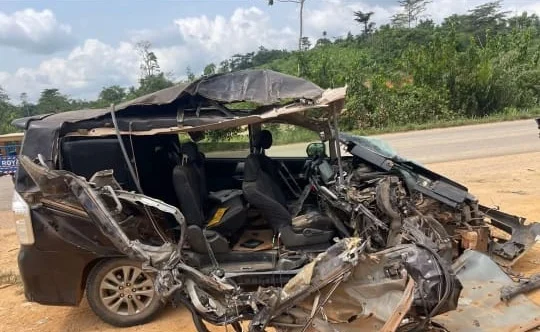
While the NRSA has launched investigations into the stability of these vehicles, authorities warn against jumping to conclusions.
Experts point out that improper conversion can affect stability, but it is not the sole brand to undergo such modifications.
The statistics suggest that vehicle condition is often the last cause of road accidents . The focus on specific brands, therefore, distracts from the primary causes of crashes: driver behaviour.
The Real “Killer” on Ghanaian Roads: Human Behaviour
If commercial vehicles aren’t the top offenders and vehicle type is rarely the primary cause, what is fuelling the crisis? The answer lies squarely with the driver.

The Director-General of the NRSA, Abraham Amaliba, has attributed the sharp rise in accidents primarily to reckless driving and overspeeding .
The Danger of Speed
Speeding is the single greatest factor in road fatalities. The NRSA reports that excessive speeding accounts for more than 60% of collisions nationwide . In fact, some assessments have found that 71% of private vehicles exceed posted speed limits, particularly on weekends when speeding is twice as frequent as on weekdays .
When you combine speed with the chaotic nature of Ghana’s roads, the results are deadly.
“Overspeeding, which is the doing of the driver, contributes to most accidents and crashes on our roads,”
Amaliba stated.
“Even on poor roads, if you are careful and abide by the limits, we could have reduced the numbers” .
The “Hidden Killer”: Impatience
Beyond the raw data on speeding lies a psychological factor that fuels reckless behaviour:
impatience. As one observer noted,
“Among the countless causes of road crashes, impatience seems to play a far bigger role than we admit” .
This impatience manifests as:
-
Dangerous overtaking: Drivers risk head-on collisions to save a few seconds.
-
Horn abuse: Drivers use horns to pressure those ahead to move faster, often forcing them into unsafe maneuvers .
-
Disregard for traffic flow: This behaviour contributes to the chaos that makes roads unpredictable and dangerous.
The Gender Dimension: A Crisis of Behaviour
The statistics also highlight a severe gender disparity in road fatalities. Between January and November 2025, out of 2,600 deaths, 1,937 were males .
Men account for nearly 80% of road fatalities . Analysts attribute this not to biology, but to behaviour.
Men make up the overwhelming majority of drivers and are statistically more likely to speed, flout regulations, and take risks behind the wheel .
Secondary Factors: Roads, Enforcement, and Maintenance
While driver behaviour is the primary cause, the shocking rise in fatalities : an 18.9% increase in deaths in early 2025 compared to 2024, is exacerbated by systemic failures .
Poor Road Conditions
Potholes and inadequate street lighting contribute significantly to crash severity. Roads like the N1 and Tema Motorway feature deep gullies that force drivers into sudden, dangerous manoeuvres . The lack of proper lighting reduces visibility, making night driving particularly perilous .
Weak Law Enforcement
There is a prevailing culture of impunity on Ghanaian roads. While the Road Traffic Act provides for severe penalties—including up to three years imprisonment for causing death by dangerous driving, enforcement remains weak .
Advocates are now pushing for Automated Speed Enforcement (cameras and speed guns) to replace manual policing, which is often inconsistent. Global best practice shows automated systems can reduce fatal crashes by up to 37% .
Regional Hotspots: Where the Roads Are Deadliest
Road accidents are not evenly distributed across the country. The data reveals specific hotspots where the crisis is most acute :
-
Ashanti Region: The deadliest region, recording 510 deaths and over 3,700 crashes.
-
Eastern Region: Has the highest crash-to-death ratio. For every 100 crashes, 28 people die, compared to just 10 in Greater Accra. This suggests crashes here are more severe, likely due to higher speeds on highways.
-
Greater Accra Region: Records the highest number of crashes (over 3,300) but a lower fatality rate, likely due to lower speeds in congested urban traffic.
The Cost: A Public Health and Economic Emergency
Road crashes are not just statistics; they are a public health emergency. Over 30% of emergency cases at Komfo Anokye Teaching Hospital (KATH) are linked to road crashes, with victims often not surviving due to the severity of their injuries .
Economically, the impact is staggering. Preventable road deaths consume an estimated 3% to 5% of Ghana’s GDP .
The victims are predominantly within the active labour force (18-55 years), stripping families of breadwinners and the nation of its future productivity .
Conclusion: A Call for a National Mindset Change
The evidence is clear: The biggest threat on Ghana’s roads is not the trotro driver or the converted Toyota Voxy. It is the driver, often a private car owner, who chooses to speed, overtake recklessly, and drive with impatience.
While authorities call for stronger enforcement and better roads , the ultimate responsibility lies with the individual. As Chief Superintendent Alexander Obeng of the MTTD stated,
“We need a national mindset change. Education, enforcement, engineering, they must all come together” .
Until drivers accept that road safety is a shared responsibility and that arriving a few minutes late is better than not arriving at all, the silence of the morgues will continue to grow louder than the horns on our highways .

