

…Why Ghana’s Politicians Must Leave the Black Stars Out of Partisan Politics
By: Rev. Immanuel Wiafe
For many Ghanaians, supporting the Black Stars has never been an easy emotional journey.
Growing up, some of us deliberately stayed away from watching Black Stars matches not because we disliked our national team, but because we simply could not bear the heartbreak of watching Ghana lose. Every painful defeat felt personal. Every missed opportunity lingered for days. Football, after all, is more than ninety minutes of play; it is an emotional investment shared by millions.
In recent weeks, however, something refreshing has happened.
The Black Stars have begun to rekindle hope among Ghanaians. Their improved performances have united people across political, ethnic, religious and social divides. For perhaps the first time in a long while, conversations about the national team have been filled with optimism rather than frustration. The joy has been genuine, and the support has been spontaneous.
This is precisely why many Ghanaians were unsettled by comments attributed to Presidential Staffer Nana Yaa Jantuah, suggesting that the Black Stars’ recent improvement is “apparently the result of President Mahama’s good leadership” and contrasting it with the team’s performance under the previous administration.
Whether intended as political praise or casual commentary, such remarks raise an important national question: Must everything in Ghana become a political contest?
Football Belongs to Ghana, Not Political Parties
The Black Stars do not represent a government.
They do not belong to the New Patriotic Party (NPP), the National Democratic Congress (NDC), or any other political movement. They belong to every Ghanaian.
When the national anthem is played before kick-off, the players do not wear jerseys bearing political party colours. They wear the colours of Ghana. Their victories belong to the entire nation, and so do their defeats.
Reducing sporting achievements to political accomplishments risks dividing what should naturally unite us.
Football has always served as one of the few spaces where political differences temporarily disappear. A taxi driver, lecturer, trader, farmer, pastor, student and politician can all celebrate the same goal with equal passion. That unity is priceless.
Politics Should Not Claim Every Victory
There is no doubt that governments contribute to sports development through funding, infrastructure, policy and institutional support. Every administration deserves recognition where genuine investments produce measurable results.
However, claiming direct political ownership of victories on the football pitch oversimplifies reality.
Success in football is built on years of planning, coaching, player development, administration, technical expertise, investment by successive governments, and, above all, the dedication of the players themselves.
Likewise, poor performances cannot always be laid entirely at the doorstep of a particular government.
Sport is influenced by many variables that extend well beyond political leadership.
Let’s Protect What Is Bringing Us Together
Ghana’s political climate is often intensely polarised. Public debate has become increasingly partisan, with almost every national issue viewed through political lenses.
Football has offered a welcome escape.
For two weeks, many Ghanaians have celebrated together without asking who voted for whom. Social media timelines have been filled with football discussions rather than political arguments. Families and friends have shared moments of national pride.
Why interrupt that harmony?
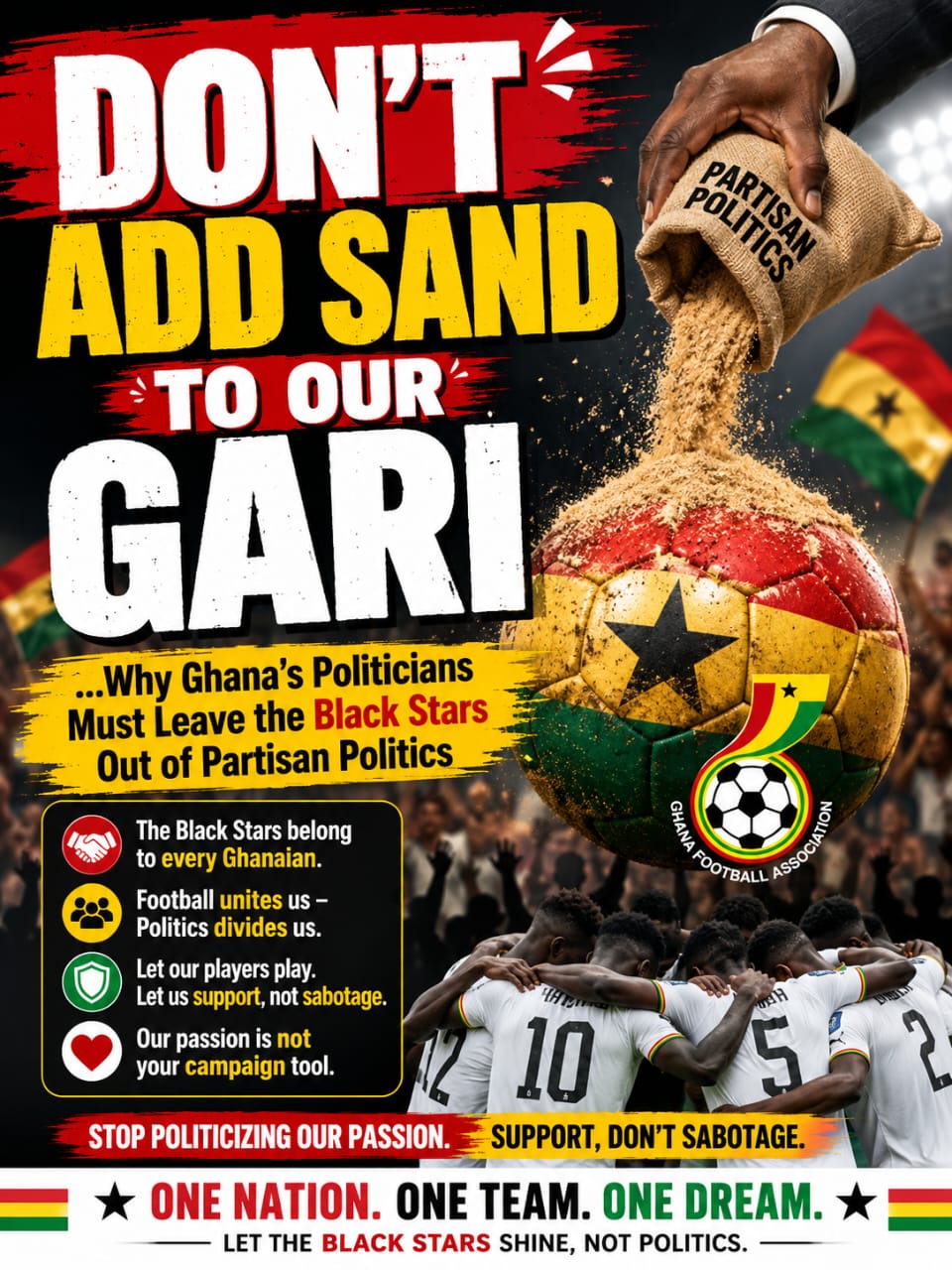
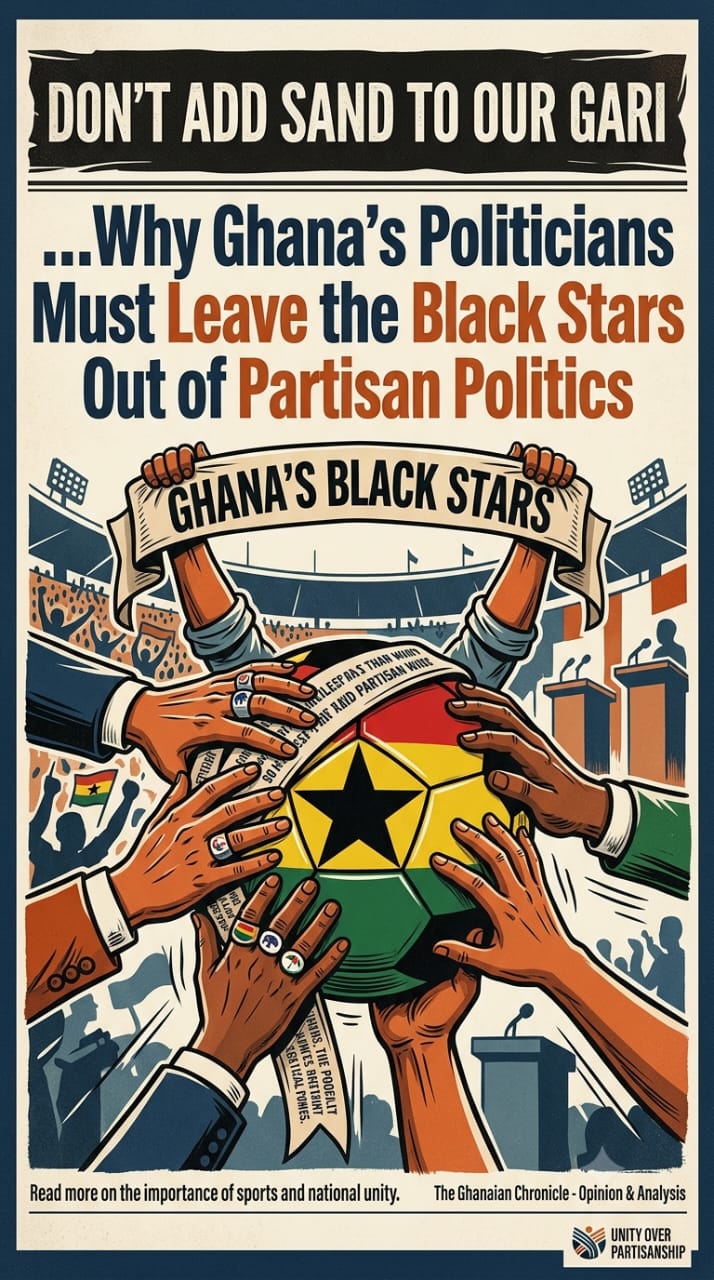
As the popular Ghanaian saying goes, “Don’t add sand to our gari.”
When gari is already enjoyable, adding sand only spoils the meal. Likewise, when football is giving Ghanaians joy and unity, introducing unnecessary political narratives only contaminates the experience.
A Call for Measured Public Communication
Public office comes with influence.
Statements made by government appointees, opposition figures and other public officials carry significant weight. For that reason, communication should always be measured, responsible and mindful of national cohesion.
Not every positive national development requires political ownership.
Sometimes, the highest form of leadership is allowing citizens to celebrate together without introducing partisan interpretations.
This is not about silencing anyone’s political opinions. It is about recognising moments when national unity is more valuable than political point-scoring.
Beyond Today’s Government
This appeal is not directed solely at the current administration.
It is addressed to every government past, present and future.
Whichever political party occupies the Jubilee House tomorrow should resist the temptation to convert every sporting success into political capital. Likewise, the opposition should avoid politicising every setback.
The Black Stars have endured enough pressure on the field. They should not be burdened with the weight of political rivalry off it.
Let football remain football.
Let the Black Stars remain Ghana’s team.
And for once, let us enjoy the beautiful game together.
Please, politicians don’t add sand to our gari.

